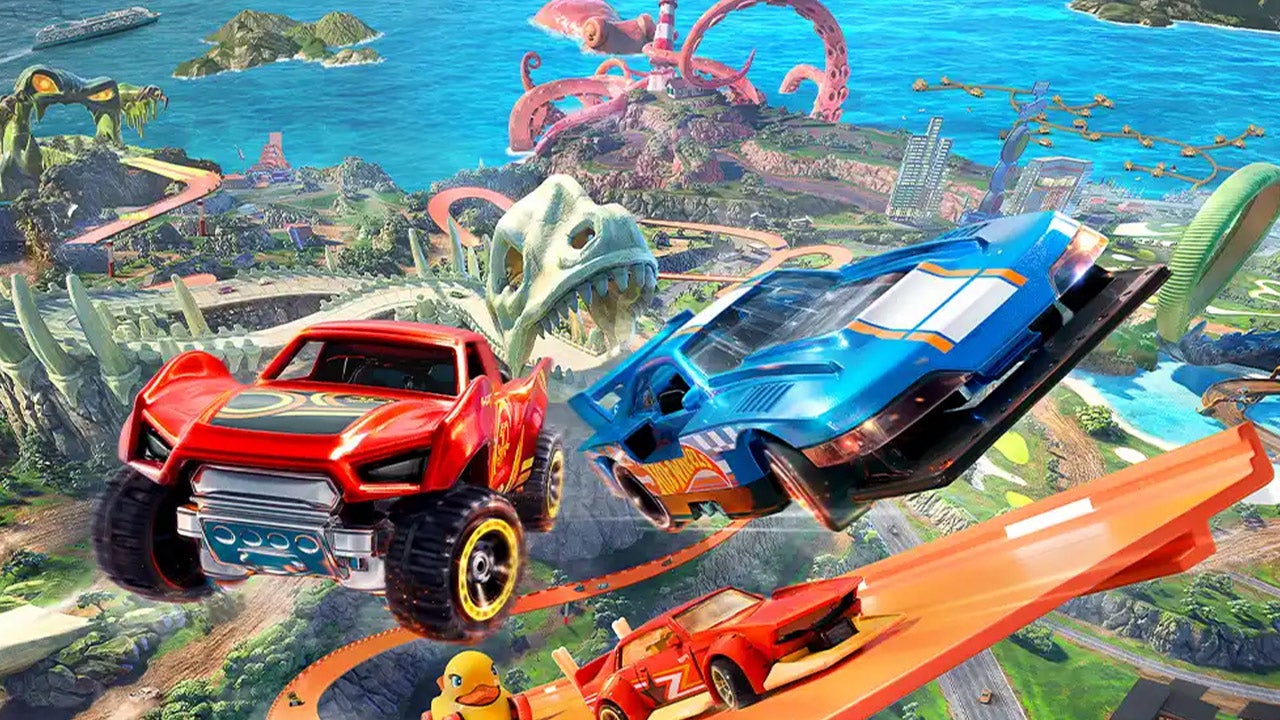

Giving the modern Hot Wheels racing series a radical, Burnout Paradise-inspired overhaul sounds like a pretty fabulous idea when you say it aloud. That Criterion Games classic is, after all, one of the most revered arcade racers in the business – even if it was ultimately the last proper Burnout we ever got. Unfortunately, Hot Wheels Infinite Rush has sacrificed far, far too much of what makes developer Milestone’s initial pair of Hot Wheels Unleashed games so eye-catching, zany, and special. Infinite Rush’s four modestly sized maps weave familiar bits and pieces of plastic track through otherwise unmemorable slabs of landscape and basic city blocks, and they totally lack the scope and spectacle of the Unleashed series’ life-sized skate parks, construction sites, and neon arcades. The racing may be fine and functional, but Infinite Rush is disappointingly basic and bland compared to its existing brethren, so it’s difficult to recommend over either of them.
Hot Wheels Infinite Rush is instantly recognisable as a Milestone Hot Wheels game thanks to its unmatched ability to present these car models in an uncannily photorealistic way. The cars still broadly look fantastic. From zinc to plastic, the surfaces of every model gleam with authenticity and – despite the fact it’s been this way since the first one arrived in 2021 – it still remains thoroughly impressive to me how terrific they look on screen. They just look real.
Unfortunately, they no longer appear to accumulate wear and tear like they did in the Milestone’s earlier games. Upon reaching the end of a race, my cars now look just as factory fresh as they did when I started. The scratches, rubs, scuffed plastic, and kerb rash that builds up on cars in the Unleashed games is a big part of what pumps up their credibility; that is, making the cars look and feel like they’ve just tumbled down the driveway a dozen times really seats them into the maps and makes them look like actual play-worn toys. In contrast, Hot Wheels Infinite Rush feels glossy and consequence-free. Am I missing something here? A hidden setting? Was this an intentional change for Infinite Rush for some unknown reason, or a licensor change-of-heart? Whatever it was, it’s a really weird step back and I’m not a fan.
Sister from Another Blister
It appears about one-third of the options that make up the roughly 150-car roster are new, rather than recycled. This is welcome, as it certainly doesn’t make much sense to keep wheeling out the same cars when there are almost 60 years of Hot Wheels castings to choose from. That said, the garage is still weighted very heavily towards new and recent models. There’s a decent smattering of early to mid-2000s castings, including AcceleRacers, but there’s really nothing here for Gen X parents or grandparents to share with younger players. The ’70s, ’80s, and ’90s remain woefully underrepresented. I get that older players aren’t really the primary audience of a licensed Hot Wheels game, but I know that my sons’ Hot Wheels collection is like a core sample of Hot Wheels history. It’s got recent cars, my childhood cars, and old cars from their uncles – and even great uncle. I get the feeling that’s probably a pretty common occurrence. The balance in Infinite Rush is just… off. There are definitely times it feels like it was more important for this to be a catalogue of cars kids can still see at the shops rather than a rummage through the toyline’s past.
Infinite Rush is also missing the pop culture cars that were fixtures in the Unleashed games. The fact that it features Ferrari is neat enough, considering the Prancing Horse’s decade-long absence from the real-life Hot Wheels line-up from 2015 to 2025, but the lack of any movie or TV cars feels a bit cheap.
Infinite Rush uses a similar class system for the cars as Unleashed 2, although it dials it back to four distinct classes rather than six: Versatile, Speeder, Drifter, and Titan. Each has nuances you need to cater for as you drive. For instance, Titans are strong but bulky – and they have extra long boost meters to compensate. However, run your boost all the way down to zero and your default speed will be strangled momentarily as your engine coughs back to life. Versatile racers have a drift bar that’s consumed in chunks, meaning you can’t stop a boost once you’ve started. It means they’re not a great fit for navigating the urban, grid-like portions of the maps, because it can be hard to force them into the right direction when in the middle of a briefly unstoppable boost.
Drifters are my preferred class, since they’re the easiest to sling sideways and therefore the best fit for an arcade racing game. The other classes are less satisfying to drift, and there sometimes seems as if there’s even a bit of a speed penalty for doing so. There were definitely occasions it was overtly faster to Hail Melon around a corner, Ross Chastain-style, than it was to slide into it properly. This shouldn’t really be the case in any arcade racer.
Toyz N the Hood
The biggest problem with Infinite Rush is how surprisingly generic the open-world approach makes it feel. It doesn’t have a single, large open map to explore like, say, Burnout Paradise or Forza Horizon 6. Instead, there are four separate, modestly sized islands – each themed in slightly different ways. There’s Wheelswood, a commercial-style, downtown-inspired map; Tentacle Bay, another city-oriented environment, only with a little more open countryside; Gearville, a desert-themed, industrial zone; and Drifty Temples, an East Asian-inspired island. I just find myself blazing through them, smashing through bushes and benches. There’s some decent imagination on display – and I do think the huge Hot Wheels Mount Rushmore on Gearville is pretty cute – but broadly speaking there’s just not much that grabs my attention. Not even the big, plastic animals.
In the Unleashed games, you find yourself racing through half-built skyscrapers above the clouds – or staring up at enormous arcade cabinets, which might as well be skyscrapers themselves with the way they loom over your tiny toy cars, from down on the sticky carpet. Infinite Rush has absolutely none of this scale, and it’s all the worse for it. They’re not quite believable dioramas, even if they’re filled with moulded plastic props. But they’re not quite real places either – even if the default measure of distance to my next waypoint is metres. 800 metres away, in a car that’s ostensibly three inches long? Something’s not adding up.
In a word, these maps are bland. You just drive back and forth across them, competing in a genre-typical range of event types. The racing is still fine, although the tracks are nowhere near as interesting anymore because they simply can’t use their surroundings in the same way as the Unleashed games can. There you can race on the floors, across the furniture, up in the air vents – you name it. Infinite Rush has none of that. Worse, a lot of the side activities that appear to be here to justify these open-world maps are just busywork – like photograph challenges that tell you exactly where to take them, or checkpoint collections that’d be a lot less trivial to complete if you actually had to dodge traffic (which you don’t; smashing through them doesn’t even really slow you down).
There was probably a way to experiment and take the series to an open world without sacrificing the sense of scale Unleashed got so right. Could the desert map have been built on a beach, or one of the other maps laid out in the foyer of a toy store? Anything like this would’ve given the backdrops the scale Infinite Rush lacks. Could more of the architecture have been household objects, with cereal box buildings standing side by side with Hot Wheels garage playsets, and painted roads filling the gaps between the iconic orange track pieces? I just feel like there was a more imaginative way to tackle this shift. 2023’s LEGO 2K Drive did this approach better overall, but unfortunately that game is already completely delisted in digital stores.
The profound shift in map philosophy is doubly disappointing considering the improvements Infinite Rush makes elsewhere. For instance, it now comes with four-player splitscreen, which would’ve been amazing fun in the massively more imaginative Unleashed maps. It also now features the ability for AI to race on your custom tracks, which would’ve been another huge boost to longevity for the older games. I would’ve loved to have seen how the AI handled the wild leaps of the crazy routes I’ve created in the past (especially since Infinite Rush is way, way more restrictive in terms of the height limit than the Unleashed games – which feature multi-level maps with a ton of vertical space). Infinite Rush also features the new ability to change out wheels as part of the customisation suite, which speaks to me as a 40-odd-year-old diorama-building dork who loves swapping out wheels on his Hot Wheels cars. Okay, they’re not always mine, but my boys aren’t using them anymore; just don’t tell them I’ve been attacking their collection with a power drill.