
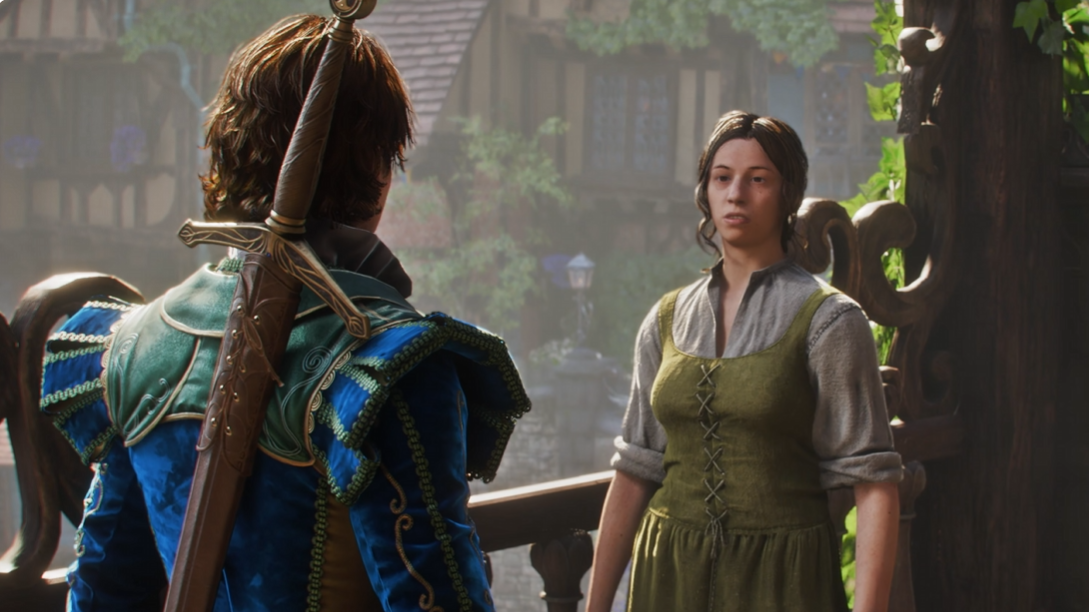

Ever since the new Fable got its big gameplay reveal in January, fans have been comparing it to the originals, and pointing out some of the beloved features from the Xbox and 360 trilogy that haven't made the cut.
One of those beloved features is the morality-based character morphing system, which altered the appearance of your character based on their actions in the world. For example, if you were “good” you’d spawn a halo over your head, but lace your acts with “evil” intentions and you’d see devil horns sprouting from it.
IGN spoke to Peter Molyneux, who led Fable developer Lionhead and who has just released his new game, Masters of Albion, into early access on Steam, to get his thoughts on the lack of the fan-favorite feature.
“Yeah, that's a real shame. I don't know why they've done that,” Molyneux said, before theorising what the reason may be. “I mean, it's hard to do that because to do it well in today's incredibly high definition world just makes it more tricky. And to do that and to allow different genders, that doubles and triples your work. But I wonder if there is going to be a little bit of evil alignment and good alignment in there. I hope so.”
Well, there will be a morality system in the new Fable, just one that is nowhere near as binary in its perspective of “good” and “evil” compared to the original trilogy's version. Earlier in 2026, IGN sat down with Playground founder Ralph Fulton to learn all about the new Fable. During that interview, he explained the studio’s decision not to include the feature in the reboot.
“That sort of character morphing feature, obviously a really central part of the original games,” Fulton began. “It's not in ours. And I'll tell you why. There's probably a couple of reasons. One, I guess it's about that high level principle I was talking about, that there is no objective good and evil. And the original games were predicated on there being an objective good and an objective evil, and you were somewhere along that scale, and that's what determined how your appearance changed.”
“But for us, that doesn't really work,” he continued. “The way I've described our morality system working, you're never that thing, absolutely. You're different things to different people based on what they like or what they choose to value. So, that's one reason that it didn't work. There's another reason, which is in our game, you build reputation based on the settlement, the town, the city that you're in, the part of the world that you're in. But when you go to a new place, a place you've never been to before, you walk in without any reputation and thus nobody knows what to think about you. And you can almost, through your behavior, through your choices, form completely different reputations, a completely different identity, if you like, in that place from the place that you were last time. And you can do that across all the locations in the game.”
“Now, you couldn't do that if you walked in with horns and a trident. Your reputation would precede you in that instance. And honestly, that ability to be completely in control of your identity and thus what people think of you felt more important to us than that legacy feature. So, it worked great in those games. It didn't seem to fit in ours, so we don't have it.”
You can check out our big interview with Ralph Fulton about Fable here, as well as learning about how you can marry each and every one of its 1,000 NPCs.
Simon Cardy is a Senior Editor at IGN who can mainly be found skulking around open world games, indulging in Korean cinema, or despairing at the state of Tottenham Hotspur and the New York Jets. Follow him on Bluesky at @cardy.bsky.social.